Closing Night: Swan Song

20

Details

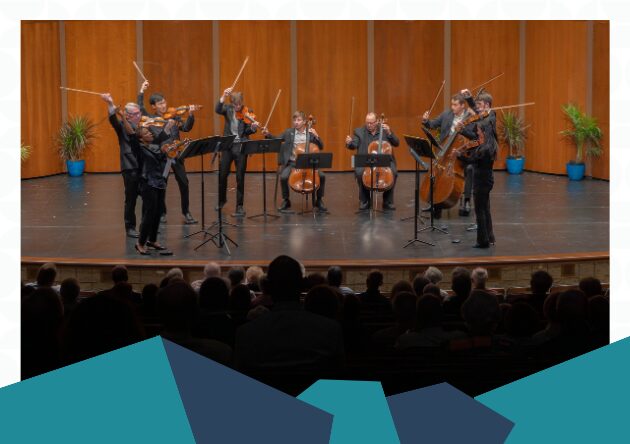
A triumphant finale featuring witty Beethoven, two fond farewells, and Mendelssohn’s exuberant Octet.

A live-stream of this concert is available through a partnership with Chamber Music Detroit’s CameraMusic series.
Click here to purchase tickets for the virtual concert

Program

Ludwig van Beethoven • Clarinet Trio in B-flat major, Op. 11

Allegro con brio
Adagio
Tema con variazioni
View Program Notes

During his first decade in Vienna, the young Beethoven enjoyed great success in the aristocratic salons of the city as a pianist and improviser.  His piano and chamber works from this period show the emergence of his individual voice, gradually freeing himself from the influence of Haydn and Mozart and establishing himself as the leading composer of the day.

Among the stylistic novelties of the present trio, one notices the greater-than-usual contrasts among the themes of the first movement, the unexpected (and quite audible) jumps into new keys, and the considerable technical demands on the players.  The clarinet part was written for Franz Joseph Bähr, a prominent Viennese musician.  It was dedicated to one of Beethoven’s aristocratic patrons, the Countess Maria Wilhelmine von Thun–the mother-in-law of Count Razumovsky, for whom Beethoven later wrote three of his greatest string quartets.

In its own day, the present trio was noted mainly for its last movement–a set of variations on an aria from the then-popular opera L’amor marinaro (“Sailor’s Love”) by Joseph Weigl.  The increasingly complex variations go beyond simply ornamenting the tune; they sometimes take it apart, concentrating on only some of its parts, not all of them.  The final variation is complete with the “Beethoven trill” (a long trill on the piano, found in a large number of his works), a more or less expected switch from 4/4 to 6/8 time but a surprising return to 4/4 in the last few bars.

© 2026 Peter Laki

David Serkin Ludwig • Swan Song

View Composer Notes

I composed Swan Song as the third in a triptych of pieces that are inspired by other works from the repertoire that have a personal meaning to me. Perhaps “inspired” isn’t a strong enough word, because these pieces draw directly from the materials of this music from the past (I have in my mind the image of making my own sculpture out of the same bucket of clay) and what compels me is the idea of reworking those materials as a part of a deeper connection to the tradition. But for Swan Song in particular, I felt more like I was writing a play with many characters who are having separate conversations about the same piece of music: Schubert’s Fantasy for Violin and Piano in C major, D. 934, a work from Schubert’s extraordinary late period (perhaps “late” isn’t the right word, either, when that period describes the work of a composer barely 30 years old).

The term “swan song” in music is most closely associated with Franz Schubert, whose last songs were collected and titled (posthumously) Schwanengesang, as if these were Schubert’s last beautiful utterances—and perhaps of all composers, his music speaks the most of inner sadness, even at its most gemütlich. In writing a new work for violin and piano I thought immediately of Schubert’s Fantasy, which is a work that dates from the last couple of years of his tragically short life.

Swan Song models Schubert, weaving in and out of music that is not a series of miniature movements or variations, but a chain of related passages that linked together form a fantasy. The opening passage of Swan Song appears several times throughout the piece, each time a little different (but always sparkling!), as if transformed by all of the music preceding it. In between are fast passages with quick exchanges between violinist and pianist, music in the extremes of volume and register, and many little games and conversations with Schubert.

Like the play mentioned above, the sections have many characters, with their exits and their entrances, each making a statement and then stepping back from the next to take center stage. At one point, Schubert himself makes a brief appearance in Swan Song, but he is a phantom who emerges into the light and returns to the background as quickly as he appeared. Finally, after increasingly fast music that seems to plow headlong into a brusque ending, hope appears, rising toward a resolution of the quiet questions asked in the first twinkling sonorities of the piece.

Swan Song was commissioned by Carnegie Hall for violinist Benjamin Beilman, and was premiered November 14, 2013 with Beilman and pianist Yekwon Sunwoo.

David Popper • Requiem for Three Cellos and Piano, Op. 66

View Program Notes

Its unusual scoring for three cellos and piano (originally with orchestra) has conferred on this beautiful work a special place in the repertoire.  David Popper was one of the greatest cellists of his time; he was friends with both Franz Liszt (who brought him to Budapest to teach at the new conservatory there) and Johannes Brahms (with whom, and with violinist Jenő Hubay, he gave the premiere of Brahms’ Piano Trio No. 3).  He composed prolifically for his own instrument, including five concertos and a large number of virtuoso solo pieces that are cherished by cellists everywhere.

The Requiem was written in memory of Popper’s friend, the music publisher Daniel Rahter.  An intensely lyrical, moving work, it opens with a melancholy theme in which the three cellos are heard together as a trio.  The second theme bears a striking resemblance to Schubert’s Ave Maria; here each cellist emerges as a soloist, taking turns in playing the melody.  The two themes undergo an extensive harmonic and contrapuntal development, before a recapitulation of the initial melody restores the initial calm.  The tranquil ending does perfect justice to the idea of requiem–eternal rest.

© 2026 Peter Laki

Felix Mendelssohn • Octet in E-flat major, Op. 20

Allegro moderato ma con fuoco
Andante
Scherzo – Allegro leggierissimo
Presto
View Program Notes

In the manuscript of his Octet, the 16-year-old Mendelssohn noted:

This Octet must be played by all instruments in symphonic orchestral style.  Pianos and fortes must be strictly observed and more strongly emphasized than is usual in pieces of this character.

Yet there were really no other “pieces of this character” to speak of.  True, Louis Spohr had written some works for eight string players, but those were double quartets, conceived as dialogs between two separate groups.  Mendelssohn, on the other hand, treated his eight players as a single, integrated unit, effectively creating a new genre of chamber music in the process.

In all four movements, Classical gestures are magnified and greatly expanded upon.  The first movement bursts with youthful energy.  The second begins and ends in a gentle pianissimo, evoking a nocturnal mood, but there are some extremely powerful emotional outbursts in between.  Next comes the first in a long line of Mendelssohnian scherzos in a very fast tempo and of a light and impish character.  In the concluding Presto, finally, the young composer pulled out all the stops.  He wrote a brilliant fugue, as a bow to the music of the Baroque which he had already begun to study and which would play such an important role in his later life.  The quote from Handel’s Messiah (“And He shall reign for ever and ever”) cannot be missed.  But there is also plenty of playfulness in the movement, along with some harmonic surprises that would have made Handel raise his eyebrows in disbelief mixed with admiration.

© 2026 Peter Laki

Tickets

Parking & Entrance

Program Notes

Featured Artists