Spirited Exchanges

10

Details

Energetic chamber music brimming with wit, rhythmic drive, and bold exchanges between strings and piano.

Afterglow Reception

Following the concert, you are invited to join us for an afterglow reception with the artists hosted by Gwen & S. Evan Weiner, Sandi & Claude Reitelman, and Janelle McCammon & Raymond Rosenfeld.

Program

Joseph Haydn • String Quartet in D minor, Op. 76, No. 2, “Quinten

Allegro
Andante o più tosto Allegretto
Menuetto: Allegro ma non troppo
Vivace assai
View Program Notes

After returning from his second and last London sojourn, Haydn composed no more symphonies.  Before embarking on the two great oratorios, The Creation and The Seasons, he completed what would be his last full set of string quartets in 1796–97, and dedicated them to a Hungarian aristocrat, Johann Georg von Erdődy.  This opus contains several of Haydn’s most celebrated quartets, including the C major work with the variations on the Imperial Hymn and the B-flat major quartet nicknamed “The Sunrise.”

The present work, whose dark dramatic quality is consistent with the usual connotations of the D minor tonality, is known as the Quinten (“Fifths”) because the main theme of the first movement features that interval prominently, in long-held half-notes.  The simple motif of a pair of descending fifths was enough for Haydn to construct a movement of great complexity and diversity.

The second movement is an Andante, but Haydn added the words o più tosto Allegretto (“or rather Allegretto”) to the tempo marking, to make sure the tempo did not drag.  The gentle D major melody, played by the first violin, is, at first, accompanied pizzicato (with plucked strings) by the other instruments.

In an unusual move, the minuet is written as a rather austere two-part canon, with the viola and cello imitating the two violins at the distance of one measure.  This somewhat stiff minuet is followed by a trio that would resemble a folk-dance over a drone bass–were it not for the odd repeated chords that precede each one of the dance strains.  The recapitulation of the minuet only reinforces the uneasy feeling.  The tensions are not resolved until the final movement—a Vivace assai that begins in an agitated manner in D minor before the key changes to a bright and exuberant D major.

© 2026 Peter Laki
Dmitri Shostakovich • Two Pieces for String Octet, Op. 11

Prelude
Scherzo
View Program Notes

Shostakovich was still a student at the Leningrad (St. Petersburg) Conservatory when he wrote these two pieces, but they are anything but “student works,” in the sense of being under the influence of any teachers.  The young man was fearlessly original at a time when, during the early days of the Soviet Union, many artists earnestly believed that a new society required radical innovation in the arts as well.  (They were soon disabused by the powers-that-be.)

After a solemn opening, the first movement (Prelude) includes episodes in turn meditative, mysterious and animated.  A virtuoso flourish for the first violin is immediately followed by a brooding Adagio, to conclude with a return of the mysterious-sounding episode.

The Scherzo foreshadows many of Shostakovich’s ferocious fast movements from later years.  It is based on a motif consisting of four notes, repeated obsessively throughout the piece, somewhat similarly to the D-S-C-H motif that plays such a crucial role of many mature works by Shostakovich.  This motif is introduced at the beginning, and then–after a brief Moderato section where the music appears to be slowing down only to gather momentum–a frenzied development gets underway.  The excitement continues unabated to the end.

Shostakovich dedicated these two pieces in memory of his friend Vladimir Kurchavov, who died of tuberculosis in 1925, at the age of 25.

© 2026 Peter Laki

Robert Schumann • Piano Quintet in E-flat major, Op. 44

Allegro brillante
In modo d’una Marcia, un poco largamente
Scherzo, molto vivace
Allegro ma non troppo
View Program Notes

One of Schumann’s most popular works, the Piano Quintet, reflects those extreme mood swings that characterized the composer’s mental state at the time of composition.  The despondency of the second-movement funeral march is followed by a carefree Scherzo, with rapid scales scurrying up and down.  Framing those two emotional poles are an energetic Allegro brillante in sonata form that combines solemn, lyrical and playful moments, and a finale full of zest, jumping happily from key to key and culminating in a grandiose fugue, in which the melody of the first movement returns.

Schumann dedicated the Quintet to his wife, the great pianist, née Clara Wieck.  During her long life (she outlived her husband by 40 years) she participated in so many performances of this work that her biographer Nancy Reich aptly called it her “signature piece.”

In chamber music written for piano and strings, the piano traditionally plays the leading role.  This was the case in the piano trios and quartets of Mozart and Beethoven, and even more so in the works of the early 19th century virtuosos (people like Moscheles and Kalkbrenner, now forgotten but crucial to Schumann’s development) who wrote for piano and instrumental ensembles of varying sizes.  Schumann, while not taking anything away from the piano, gave the strings a near-equal status, entrusting them with important melodic material, giving plenty of solo turns both to the individual instruments and to the whole quartet as a group.  He was the first major composer to combine the piano with the string quartet (Schubert’s “Trout” Quintet, an important predecessor, includes the double bass and has only one violin).  With this work, Schumann created a whole new genre, inspiring such later piano quintets as those by Brahms, Dvořák, Franck and Shostakovich.

© 2026 Peter Laki

Tickets

Parking & Entrance

Program Notes

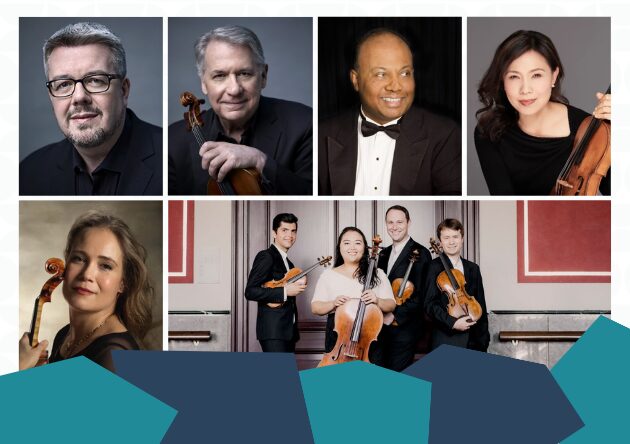
Featured Artists