Opening Night: Signatures in Sound

Closing Night

Details

A vibrant, large-scale celebration featuring baroque brilliance, contemporary energy, and the exhilaration of multiple pianos and ensembles sharing the stage.

Pop-Up Gallery

Doors open at 6 p.m. for a pop-up gallery featuring visual artist Elizabeth Youngblood.

Opening Night Reception

Detroit Country Day School Black Box Theater
Sponsored by JPMorgan

Join the Great Lakes Chamber Music Festival for a reception following the concert.
Suggested donation to attend is $50 per person.

Click here to learn more and reserve your spot.

Program

David Serkin Ludwig • Missa Brevis

Kyrie
Gloria
Credo
Sanctus
Agnus Dei
View Composer Notes

I have always been fascinated by the sacred mass as a musical form.  Each movement developed its own personality through the centuries, dictated by both the content of its words and contemporary convention.  The individual identity of these movements eventually surpassed in priority the text of the mass, and that is what I am interested to explore in the Missa Brevis. The Brevis in the title refers to the briefness of the piece and the reduction of the movements into five short concentrated parts, each with its own character.

The Kyrie introduces the work with a loud declamatory chord that soon dissolves into floating snapshots of music by Guillaume Machaut, a composer from 14th century France (and the author of the first full mass.)  The Gloria opens with an extended brass fanfare that is followed by a conversation between the oboe and English horn.  The third movement is the Credo, which is the large middle part of the traditional mass; as it has by far the most text, many composers have opted to set music that rapidly cycles through the words with a rhythmic chanting quality, and this Credo does exactly that.  The Sanctus and Agnus Dei are coupled together, as the Sanctus begins with the bright chords of the opening answered by a hushed response in the last movement.  The Missa Brevis ends with the words “Ite Missa Est,” letting the listener know the work has come to a close.

The idea of quoting other works has been around since people first started writing down music.  I couldn’t help but think of Machaut as I was sketching this piece, and decided to include his music as if from a distant place, speaking from history, to center the piece around the very beginning of the mass tradition.  And besides, I love the music.  The cool sounds of wind instruments allow the feeling of objectivity and individuality for me—I am reminded of what Stravinsky noted in his own Mass that his exclusive use of winds made for no distance between the listener and his message of spirituality.

I was commissioned to write the Missa Brevis by conductor Michael Haithcock and his University of Michigan Symphonic Band, in consortium with the Detroit Chamber Winds & Strings and the Oberlin Conservatory of Music.

– David Serkin Ludwig
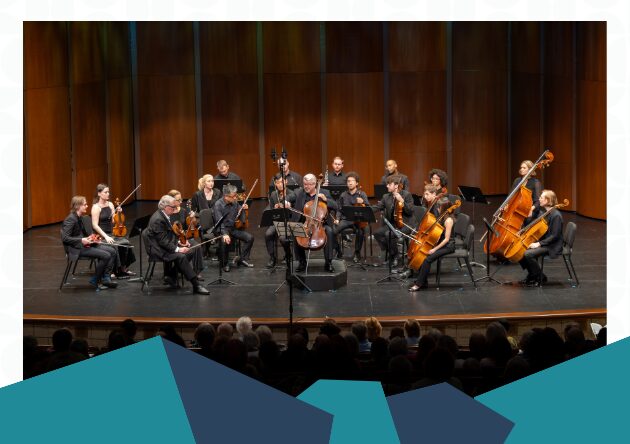
Antonio Vivaldi • Concerto for Four Violins in B minor, RV 580 (Op. 3, No. 10)

Allegro
Largo
Allegro
View Program Notes
Vivaldi’s only concerto for four violins was published in the landmark set of twelve concertos entitled L’estro armonico (“Harmonic Inspiration,” 1711).  Does anyone still believe that the “Red Priest” wrote the same concerto 500 times over, as some have maliciously suggested?  This piece has enough individual features to give the lie to that superficial judgment once and for all.  To mention just a few:  Vivaldi starts out with solos, instead of the tutti that the conventions supposedly call for.  And there are not one but two slow movements:  a Largo based on a single melodic gesture, and a Larghetto, in which each of the four solo violins plays a different kind of arpeggios (broken chords).  Even J.S. Bach, who arranged this work for four harpsichords and strings, had something to learn from his Venetian contemporary!
© 2026 Peter Laki

Wynton Marsalis • At the Octoroon Balls – String Quartet No. 1 (selections)

IV. Many Gone
V. Hellbound Highball
VI. Blue Lights on the Bayou
VII. Rampart St. Row House Rag
View Composer Notes

Wynton Marsalis’ first string quartet, At the Octoroon Balls, explores the American Creole contradictions and compromises – cultural, social, and political – exemplified by life in New Orleans. The balls were events held for white Creole men to choose their Octoroon mistresses (which meant having one-eighth Black ancestry, with one Black great-grandparent). The piece’s seven movements evoke people, places, and events in the Crescent City: “Come Long Fiddler,” “Mating Calls and Delta Rhythms,” “Creole Contradanzas,” “Many Gone,” “Hellbound Highball,” “Blue Lights on the Bayou,” and “Rampart St. Row House Rag.”

– Wynton Marsalis

W.A. Mozart • Concerto for Three Pianos in F major, K. 242

Allegro
Adagio
Rondo
View Program Notes

Mozart wrote his concerto for three pianos for three aristocratic amateurs:  Countess Antonia Lodron and her two daughters, Louise and Josepha, members of Salzburg high society.  The countess and her older daughter were apparently accomplished pianists, but the younger daughter must have been less advanced, as one may infer from the fact that the third piano part is much easier than the first two.  This made it possible for Mozart to arrange the work for two pianos, dividing the third piano part between the other two players.

Mozart was particularly fond of this concerto.  His letters reveal that he liked to play it whenever an opportunity arose.  He played the second piano part at a concert in Augsburg in October 1777.  The following year, he included the concerto in one of his Paris concerts, although he did not play in it himself.  Even after his move to Vienna in 1781, he repeatedly asked his father to send the score along so he and his pupil Josepha Aurnhammer could perform it in the two-piano version.

By the time this concerto was written, the conventions of classical concerto form were rather well established, providing the composer with a certain “blueprint” to follow, as far as the sequence and elaboration of themes were concerned.  But Mozart wouldn’t have been Mozart if he hadn’t filled out this blueprint with myriad personal touches:  slight asymmetries among the phrases, surprising harmonic turns, and endlessly ingenious ways of working with three soloists.  The slow movement is one of the most profound Adagios Mozart had yet written, and the finale combines a minuet dance with rondo form: the minuet alternates with episodes of contrasting characters.  Since there are three soloists, the cadenzas could not be improvised but had to be fully written out.  The last movement has three such cadenzas–one for the first piano, one for the second and one for the first and second together, but none for the third…

© 2026 Peter Laki

Tickets

Parking & Entrance

Program Notes

Featured Artists